

 Open here
The B2B ecommerce landscape has fundamentally shifted. Clunky portals and manual order forms are obsolete, replaced by buyer expectations for the same seamless, personalized, and efficient digital experiences they enjoy as consumers. To stay competitive, businesses must move beyond basic online catalogs and adopt a sophisticated digital strategy that caters directly to the complex needs of wholesale purchasing. This comprehensive guide outlines 10 essential B2B ecommerce best practices designed to transform your operations, from optimizing site architecture and pricing workflows to empowering your sales team with the right tools.
We will dive deep into actionable strategies that address the entire B2B lifecycle. You'll learn how to implement everything from streamlined checkout processes and robust ERP integrations to mobile-first design and account-based marketing. Each practice is broken down with practical advice and real-world examples to help you build a powerful B2B platform. For businesses at the beginning of this journey, exploring diverse e-commerce solutions is a crucial first step in building a foundation for growth.
Furthermore, we'll highlight how small but crucial details, like providing instant, downloadable product datasheets, can significantly enhance the buyer's journey. Technical buyers often need detailed specifications to share with their teams or for procurement approval. Simplifying this process with tools like the LitPDP app, which allows for one-click PDF generation directly from a product page, removes friction and accelerates the sales cycle. These are the modern standards for wholesale success, and this list provides the blueprint to implement them effectively.
1. Personalized Product Recommendations and Account Experience
B2B buyers now expect the same personalized, intuitive online shopping experiences they enjoy as consumers. Implementing a personalization engine is a cornerstone of modern B2B ecommerce best practices, as it tailors product recommendations, pricing, and content to individual accounts and their purchasing history. This strategy moves beyond a one-size-fits-all storefront to create dynamic, relevant experiences that cater directly to specific buyer needs.
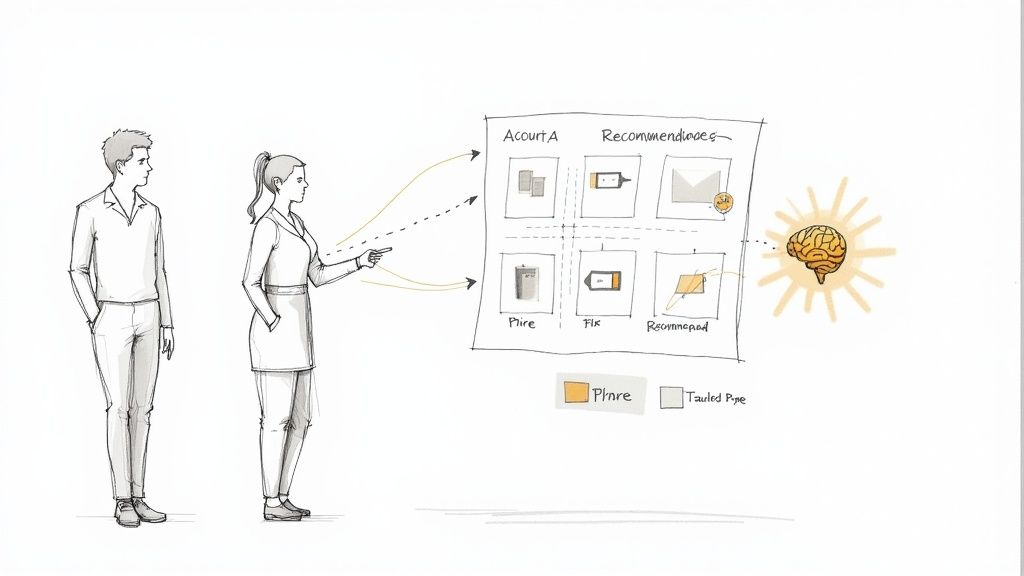
Unlike B2C, B2B personalization involves complex variables like contract pricing, reordering schedules, and industry-specific requirements. An effective system leverages AI and machine learning to analyze buyer behavior, company firmographics, and historical order data. This allows you to automatically surface the most relevant products, from complementary accessories to bulk reorder suggestions, directly within the customer's portal. This targeted approach not only simplifies the procurement process but also significantly boosts average order value and customer lifetime value. For instance, platforms like Amazon Business and Alibaba use AI to create highly customized dashboards and recommendation carousels that feel unique to each business account.
How to Implement B2B Personalization
Implementing a successful personalization strategy requires a clear, data-driven approach. Start by focusing on the data you already have and expand from there.
- Segment Your Buyers: Group customers based on industry, purchase volume, location, or past behavior. Use this to create foundational personalized experiences, such as displaying industry-specific product categories on the homepage for logged-in users.
- Leverage Purchase History: Use historical order data to power "Frequently Reordered" or "Recommended for You" sections. This is a low-hanging fruit that simplifies the reordering process for your most loyal customers.
- Integrate Key Data Sources: Connect your ecommerce platform with your CRM and ERP systems. This integration provides a 360-degree view of the customer, enabling more sophisticated personalization, like showing products related to a recent sales-assisted purchase.
- A/B Test Your Algorithms: Continuously test different recommendation models to see what resonates most with your audience. For example, you might test a "Customers Also Bought" algorithm against a "Trending in Your Industry" one to optimize for conversions.
2. Streamlined B2B Checkout and Payment Processing
The B2B checkout process is fundamentally different from its B2C counterpart, often involving multiple stakeholders, approval workflows, and complex payment terms. A streamlined B2B checkout accommodates these needs by offering flexibility and reducing friction, which is a critical component of B2B ecommerce best practices. Instead of a simple credit card transaction, B2B buyers require options like purchase orders (POs), net terms, and payment by invoice, all within a clean, intuitive interface that minimizes required form fields and simplifies navigation.
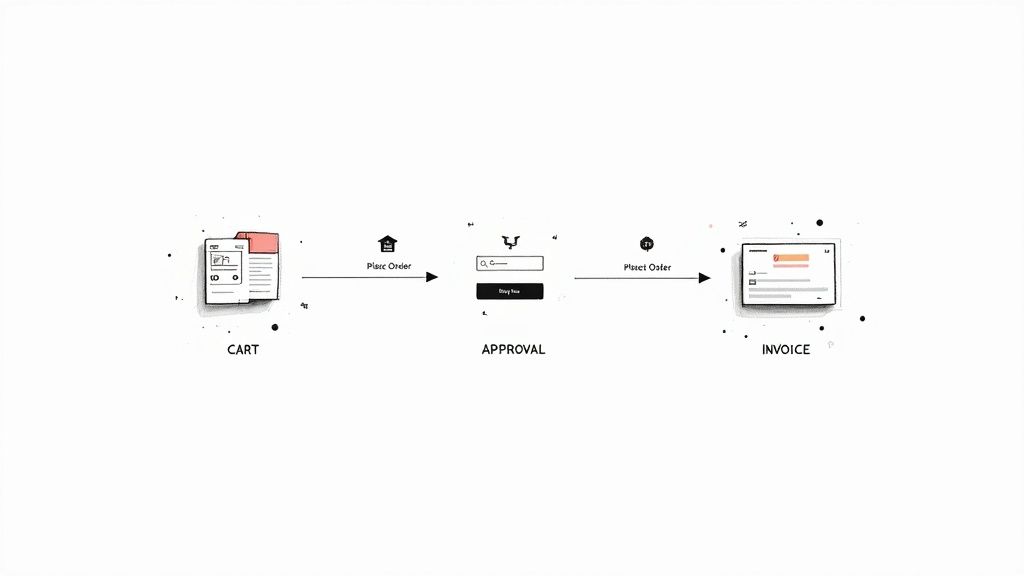
Unlike a standard one-page checkout, an effective B2B process is built for complex procurement. It supports roles and permissions, allowing a junior buyer to create a cart and submit it for approval by a manager before the purchase is finalized. Leading platforms like Shopify Plus and BigCommerce B2B Edition offer robust solutions that integrate these workflows directly. For instance, a buyer can add items to their cart, select "Pay by Invoice" with Net 30 terms, enter a PO number, and check out in just a few clicks, with the system automatically routing the order for internal approval and generating the necessary documentation. This efficiency is key to reducing cart abandonment and encouraging repeat business.
How to Implement a Streamlined B2B Checkout
Building a frictionless checkout requires a focus on flexibility, clarity, and integration. It should empower buyers, not hinder them.
- Offer Diverse Payment Options: Natively support payment methods like purchase orders, ACH transfers, credit cards, and net terms (e.g., Net 30, Net 60). Clearly display all available options early in the checkout process to build confidence.
- Simplify Form Fields: Only ask for essential information. Use account pre-population to fill in shipping and billing details for logged-in users, reducing manual entry and potential errors.
- Integrate with ERP and Accounting Software: Connect your ecommerce platform to systems like NetSuite or QuickBooks. This automates the generation of invoices and credit memos and ensures financial data is synchronized across the business.
- Provide Clear Documentation: B2B purchases often require detailed records for accounting. Ensure that buyers can easily download order confirmations, invoices, and product datasheets. For a more efficient workflow, installing an app to generate custom PDFs can make this process seamless for both you and your customers.
3. Comprehensive Product Information Management (PIM)
B2B buyers require detailed, accurate, and consistent product information to make informed purchasing decisions. Implementing a Product Information Management (PIM) system is a critical B2B ecommerce best practice, as it creates a centralized, single source of truth for all product data. This includes technical specifications, high-resolution images, safety datasheets, compliance documents, pricing, and real-time inventory levels, ensuring this data is uniform across all sales channels.
Unlike B2C where marketing descriptions often suffice, B2B procurement relies on precise data for compatibility, regulatory compliance, and operational use. A PIM system solves the common problem of data silos where information is scattered across ERPs, spreadsheets, and supplier databases, leading to errors and inefficiencies. By centralizing this information, you empower both your sales team and your customers with reliable data. For instance, platforms like Salsify and inriver PIM enable manufacturers to efficiently syndicate complex product catalogs to distributors and online marketplaces, ensuring every partner has the most current information.
How to Implement B2B Product Information Management
A successful PIM implementation hinges on careful planning and a commitment to data governance. It’s about creating a robust foundation for your entire product ecosystem.
- Conduct a Comprehensive Data Audit: Before choosing a PIM, map out all your existing product data sources. Identify inconsistencies, gaps, and redundancies to understand the scope of the project and define your data requirements.
- Establish Clear Data Governance: Create and enforce standards for data quality, format, and completeness. Define roles and responsibilities for who can create, approve, and update product information to maintain integrity.
- Integrate Key Business Systems: Connect your PIM with your ERP, CRM, and ecommerce platform. This ensures that data like inventory levels, customer-specific pricing, and order history are synchronized in real-time.
- Automate Data Enrichment: Use your PIM to automate the process of adding rich content like marketing descriptions, videos, and professional product documentation. For example, Shopify merchants can use apps like LitPDF to automatically generate and attach downloadable spec sheets to products, a process easily managed through a centralized PIM workflow.
4. Mobile-Optimized and Responsive Design
The modern procurement professional is no longer tethered to a desktop computer. B2B buyers now research products, manage orders, and make purchases on the go, making a mobile-first approach a crucial component of B2B ecommerce best practices. A responsive design ensures your storefront provides a seamless, intuitive experience across all devices, from smartphones and tablets to desktops, adapting layouts and functionality to fit any screen size. This prevents the frustration and lost sales that come from a clunky, hard-to-navigate mobile interface.
Unlike B2C mobile shopping which often prioritizes discovery, B2B mobile usage is heavily task-oriented. Buyers need to quickly reorder supplies from a job site, check order statuses, or access technical datasheets while in the field. Companies like Grainger and McMaster-Carr excel here, offering robust mobile websites and apps where users can easily scan barcodes to reorder products or access detailed specifications. A truly mobile-optimized experience considers these specific user needs, prioritizing core functions like search, reordering, and account management to reduce friction in the purchasing process. This focus on mobile usability directly translates to increased sales and higher customer satisfaction.
How to Implement Mobile-First B2B Design
Building a mobile-optimized site requires prioritizing efficiency and accessibility. Focus on what your buyers need most when they are away from their desks.
- Prioritize Core Functionality: Identify the most critical tasks your mobile users perform, such as reordering, checking inventory, and accessing account details. Place these functions front and center in your mobile navigation and user interface.
- Optimize for Performance: Mobile users expect fast loading times. Compress images, minify code, and consider using Accelerated Mobile Pages (AMP) for key landing or product pages to ensure a snappy, responsive experience.
- Simplify Navigation and Forms: Use large, easy-to-tap buttons, streamlined menus, and simplified checkout forms. Minimize the number of fields required to complete a purchase to reduce user drop-off.
- Ensure Content Accessibility: Product information, especially detailed datasheets, must be mobile-friendly. Ensure PDF spec sheets are easily viewable and downloadable on smaller screens. Apps like Print Product Page help generate clean, mobile-accessible PDFs directly from your Shopify product pages, so buyers can access critical data anywhere.
5. Account-Based Marketing (ABM) Integration
Account-Based Marketing (ABM) is a strategic approach that treats individual high-value B2B accounts as markets in their own right. Integrating ABM with your ecommerce platform aligns marketing and sales efforts to deliver highly personalized, consistent experiences across every touchpoint. This is one of the most powerful B2B ecommerce best practices because it transforms your storefront from a passive sales channel into an active, strategic tool for nurturing and closing key accounts.
Unlike broad marketing campaigns, an ABM-integrated ecommerce site delivers custom content, unique product catalogs, and specific pricing directly to logged-in users from target companies. By connecting your store to platforms like Demandbase or 6sense, you can identify visitors from high-value accounts and dynamically adjust their on-site journey. For example, a visitor from a target manufacturing firm could be greeted with a homepage banner featuring relevant case studies, shown a curated collection of industrial-grade products, and offered their pre-negotiated contract pricing, creating a seamless path from targeted ad to personalized purchase.
How to Implement ABM Integration
Integrating ABM requires deep alignment between your marketing, sales, and tech stacks. The goal is to create a frictionless and highly relevant buying journey for your most important customers.
- Identify and Prioritize Target Accounts: Use data from your CRM and predictive analytics tools like 6sense to build a list of high-potential accounts. Focus on those with the highest revenue potential, strategic value, and likelihood to close.
- Align Sales and Marketing: Both teams must agree on the target list, the key messaging, and the desired customer journey. The ecommerce experience should be a digital extension of the sales team's conversations and strategy.
- Create Personalized On-Site Experiences: Use your ecommerce platform's capabilities to customize content for specific user segments or individual accounts. This includes tailored banners, personalized product recommendations, and account-specific resources. Thoroughly planning these user flows highlights the importance of wireframes in the design process to ensure a cohesive experience.
- Equip Sales with Digital Tools: Enable your sales team to provide their accounts with custom-generated product datasheets and quotes. For instance, using a Shopify app like Print Product Page, sales reps can quickly create and share tailored PDF spec sheets that directly support their ABM efforts.
6. Advanced Search and Filtering Capabilities
B2B buyers, unlike their B2C counterparts, often arrive at a site knowing exactly what they need, down to specific part numbers, technical specifications, or compliance standards. A generic search bar is insufficient. Implementing an advanced, faceted search system is one of the most critical B2B ecommerce best practices because it empowers procurement professionals to quickly and accurately navigate vast, complex catalogs, drastically reducing friction and accelerating the time-to-purchase.
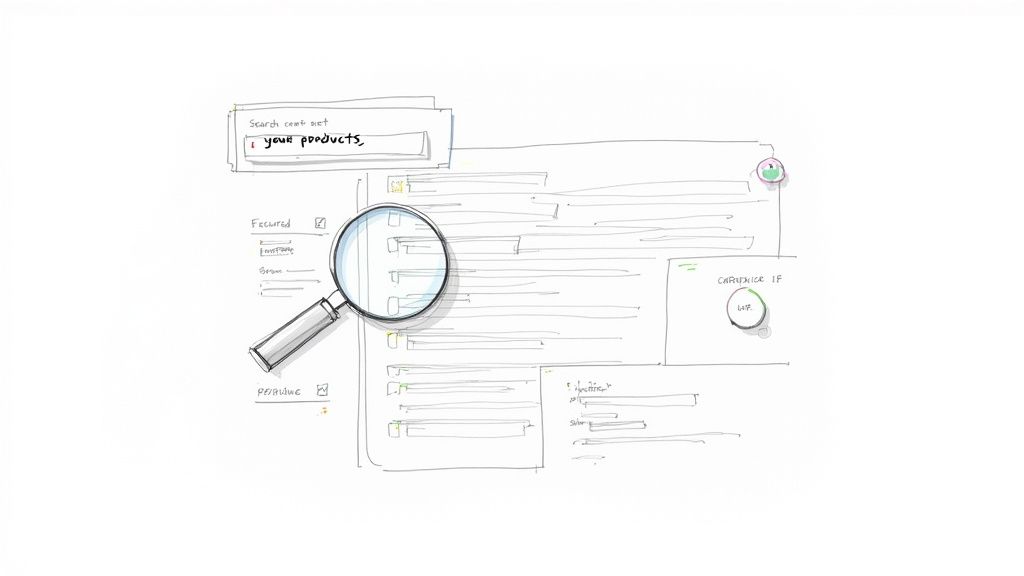
Effective B2B search leverages technologies like Elasticsearch or Algolia to provide features such as synonym mapping (e.g., "screw" also returns "fastener"), natural language processing, and highly specific filtering. Buyers must be able to filter by attributes like material composition, voltage, certifications (ISO, UL), or compatibility with existing equipment. For example, an industrial supplier like RS Components allows engineers to filter electronic components by dozens of technical parameters, ensuring they find the precise part required for a specific application without manual effort. This level of precision is not a luxury; it's a core requirement for efficient procurement.
How to Implement Advanced Search
Building a robust search function involves a strategic approach focused on understanding user intent and organizing product data logically.
- Analyze User Search Behavior: Use search analytics to identify common queries, failed searches (zero results), and the filters your buyers use most often. This data is a goldmine for refining your search logic and prioritizing which filter attributes to feature.
- Structure Your Product Data: Your search is only as good as your data. Ensure all products have complete and consistently formatted attributes. This structured data is what powers effective faceted filtering. A detailed product page with a downloadable datasheet, easily created with an app like LitPDP, can serve as the master record for these attributes.
- Implement Synonym and Abbreviation Mapping: Your search engine should understand industry-specific jargon, abbreviations, and common synonyms. Manually map terms like "aluminum" to "aluminium" or "SS" to "stainless steel" to prevent failed searches and user frustration.
- Offer Autocomplete and Suggestions: Guide users as they type by suggesting popular products, categories, or relevant query completions. This not only speeds up the process but also helps prevent typos and incorrect searches from the start.
7. Robust Security and Compliance Framework
B2B transactions often involve sensitive corporate data, large order volumes, and complex payment terms, making enterprise-grade security a non-negotiable B2B ecommerce best practice. Implementing a robust security and compliance framework builds the essential trust required for high-value business relationships. This involves protecting data in transit with SSL/TLS encryption, ensuring payment processing meets PCI-DSS standards, and adhering to data privacy regulations like GDPR.
Unlike typical B2C transactions, B2B security extends to protecting intellectual property, contractual pricing, and detailed customer account information. A breach can lead to significant financial loss and severe reputational damage. Therefore, security measures must include role-based access controls (RBAC) to ensure employees only access data relevant to their roles, preventing internal data leaks. Leading platforms like Shopify Plus provide a secure, PCI-compliant infrastructure out of the box, handling much of the technical burden so merchants can focus on their business while maintaining buyer confidence.
How to Implement a Robust Security Framework
Building and maintaining a secure ecommerce environment requires a multi-layered, proactive approach that addresses technology, processes, and people.
- Implement Multi-Layered Security: Go beyond basic passwords. Enforce two-factor authentication (2FA) for all administrative and buyer accounts, use a Web Application Firewall (WAF) to filter malicious traffic, and ensure all data is encrypted both in transit (SSL/TLS) and at rest.
- Conduct Regular Security Audits: Proactively identify vulnerabilities by scheduling regular third-party security audits and penetration testing. This helps you discover and patch weaknesses before they can be exploited by malicious actors.
- Establish Role-Based Access Controls (RBAC): Configure your ecommerce platform and integrated systems to limit data access based on job function. A purchasing agent shouldn't have access to system-wide administrative settings, and a warehouse manager doesn't need to see detailed contract pricing.
- Maintain Clear Incident Response Procedures: Develop a clear, documented plan for what to do in the event of a security breach. This plan should outline steps for identification, containment, eradication, and recovery, ensuring a swift and organized response to minimize damage.
8. Integration with ERP, CRM, and Business Systems
A modern B2B ecommerce platform cannot operate in a silo. Integrating your storefront with core business systems like Enterprise Resource Planning (ERP), Customer Relationship Management (CRM), and inventory management is a critical B2B ecommerce best practice. This creates a single source of truth, automating data synchronization for orders, customer information, inventory levels, and pricing, which eliminates manual data entry and reduces costly errors.
Unlike B2C, B2B operations rely on complex, interconnected data for contract pricing, customer-specific catalogs, and credit limits. A seamless integration ensures that when a customer places an order online, the data flows automatically to your ERP for fulfillment and invoicing, while their account information is updated in your CRM. For example, a Salesforce Commerce Cloud integration with Salesforce CRM provides sales teams with a real-time view of customer online activity, enabling more informed conversations. Similarly, a NetSuite Commerce integration ensures that inventory levels displayed on the storefront are always accurate, preventing stockouts and backorders.
How to Implement System Integrations
Building a robust integration strategy requires careful planning to ensure data flows correctly between systems. An API-first approach is essential for modern, scalable connections.
- Map Critical Data Flows: Before writing any code, create a detailed map of all data points that need to be synchronized between systems. Identify the "source of truth" for each data type, such as customer records in the CRM or inventory in the ERP.
- Utilize an API-First Approach: Choose platforms with strong API capabilities or use middleware solutions like MuleSoft or Talend to connect disparate systems. This method provides more flexibility and scalability than older, point-to-point integrations.
- Automate Document Generation: Integrations can also automate the creation of essential sales documents. To be more efficient, you can install the LitPDP app on Shopify to connect your product data directly to a PDF generation engine, creating spec sheets or datasheets on demand without manual effort.
- Implement Error Handling: Create robust monitoring and error-handling protocols. Your system should be able to flag and resolve data sync issues automatically, ensuring that a problem in one system does not corrupt data across your entire tech stack.
9. Content Marketing and Educational Resources
B2B buyers are researchers who require deep, reliable information before making a significant purchase. A robust content marketing strategy is a critical B2B ecommerce best practice because it positions your brand as a trusted authority, educates buyers, and guides them through complex decision-making processes. Unlike B2C where emotional appeal can drive sales, B2B purchasing is driven by logic, ROI, and expertise, making valuable content an essential sales enablement tool.
Effective B2B content marketing goes beyond simple blog posts. It involves creating a comprehensive library of resources such as in-depth whitepapers, detailed case studies, video tutorials, and industry-specific webinars. These assets address the specific pain points and questions your target audience has at each stage of the buyer's journey. For example, HubSpot has built an empire by offering free educational resources through its Academy, establishing trust long before a prospect considers buying its software. Similarly, providing downloadable datasheets and product specification PDFs on product pages is a key content strategy, allowing engineers and procurement teams to easily compare products and present them to decision-makers offline.
How to Implement B2B Content Marketing
Building a successful content engine requires a strategic approach focused on solving your customers' problems.
- Target Specific Buyer Personas: Develop content that addresses the unique challenges and questions of different roles within a buying committee, such as engineers, procurement managers, or executives.
- Create High-Value, Downloadable Assets: Offer detailed product spec sheets, installation guides, and case studies as downloadable PDFs. For Shopify merchants, apps like Print Product Page can instantly generate these essential datasheets, making technical information easily accessible to buyers.
- Repurpose Content Across Multiple Formats: Turn a comprehensive webinar into a series of blog posts, a downloadable whitepaper, and several short video clips. This maximizes the reach and impact of your core research and insights.
- Optimize for Search Engines: Conduct keyword research to understand what your B2B buyers are searching for. Optimize your content around these terms to attract qualified organic traffic and capture leads early in their research process.
10. Omnichannel Order Management and Customer Service
Modern B2B buyers operate across numerous channels, from your website and mobile app to third-party marketplaces and direct interactions with sales reps. An omnichannel strategy unifies these touchpoints, ensuring consistent inventory visibility, pricing, and customer service regardless of how a buyer interacts with your brand. This approach is a core component of B2B ecommerce best practices, as it creates a seamless, cohesive journey that eliminates friction and builds long-term loyalty.
Unlike a multichannel approach where channels operate in silos, omnichannel integrates them into a single, unified system. This means a buyer can start an order on their desktop, add items via a mobile app, and finalize the purchase over the phone with a sales rep, all while experiencing consistent service and real-time inventory data. Platforms like Shopify Plus and Salesforce Order Management Cloud excel at this by centralizing order data and customer profiles, allowing your team to have a complete view of every interaction. This integration is crucial for complex B2B workflows, such as managing orders that require custom quotes or specialized fulfillment.
How to Implement Omnichannel B2B Commerce
Building a successful omnichannel experience requires centralizing your data and standardizing your processes. Focus on creating a single source of truth for both inventory and customer information.
- Implement Centralized Inventory Management: Use a system that syncs inventory levels in real-time across all sales channels, including your B2B portal, marketplaces, and physical locations. This prevents stockouts and ensures accurate availability information for buyers.
- Create Unified Customer Profiles: Integrate your ecommerce platform with your CRM to consolidate customer data. This allows your sales and service teams to see a complete history of orders, inquiries, and communications, no matter which channel they originated from.
- Standardize Service and Fulfillment: Establish clear service level agreements (SLAs) and fulfillment processes for all channels. Ensure that a customer receives the same high-quality experience whether they place an order online or through a sales representative.
- Empower Sales with Digital Tools: Give your sales team access to the B2B portal to place orders on behalf of clients or send them pre-filled carts. Similarly, equipping them with tools to generate professional product datasheets or spec sheets using an app like Print Product Page ensures they can provide consistent, high-quality information during offline interactions that perfectly matches your online catalog.
10-Point B2B eCommerce Best-Practices Comparison
| Solution | Implementation Complexity 🔄 | Resource Requirements ⚡ | Expected Outcomes 📊 | Ideal Use Cases 💡 | Key Advantages ⭐ |
|---|---|---|---|---|---|
| Personalized Product Recommendations and Account Experience | High — complex ML models & account logic 🔄 | High — data engineering, ML, infrastructure ⚡ | Higher conversion & CLV; 20–30% AOV lift 📊 | Account-based selling, large catalogs, repeat buyers 💡 | Tailored experiences; increased AOV & retention ⭐ |
| Streamlined B2B Checkout and Payment Processing | Medium–High — payment/ERP integrations & workflows 🔄 | Medium — payments, finance, compliance, dev ⚡ | Lower cart abandonment; improved cash flow & conversions 📊 | Net‑terms, PO workflows, high‑volume buyers 💡 | Reduced friction; supports PO/terms and invoicing ⭐ |
| Comprehensive Product Information Management (PIM) | High — data migration, governance, syndication 🔄 | High — data teams, PIM platform, ongoing maintenance ⚡ | Consistent catalogs; faster time‑to‑market; fewer errors 📊 | Multi‑channel catalogs, regulated industries, large SKUs 💡 | Single source of truth; scalable catalog management ⭐ |
| Mobile-Optimized and Responsive Design | Medium — responsive UI, touch UX, testing across devices 🔄 | Medium — front‑end dev, QA, performance tooling ⚡ | Increased mobile conversions (≈10–20%); lower bounce 📊 | Mobile procurement, field teams, younger buyers 💡 | Improved UX and SEO; broader accessibility ⭐ |
| Account-Based Marketing (ABM) Integration | High — CRM/MA sync, account scoring, attribution 🔄 | High — marketing ops, analytics, campaign resources ⚡ | Larger deal sizes; better ROI & alignment with sales 📊 | Enterprise accounts, strategic high‑value prospects 💡 | Aligned sales/marketing; targeted revenue growth ⭐ |
| Advanced Search and Filtering Capabilities | High — data modeling, NLP, synonym & facet tuning 🔄 | Medium–High — search engineers, indexing infra ⚡ | Faster product discovery; ↑ conversions 15–25%; fewer support tickets 📊 | Technical catalogs, complex spec-driven purchases 💡 | Improved discoverability; precise results for buyers ⭐ |
| Robust Security and Compliance Framework | High — continuous audits, RBAC, regulatory work 🔄 | High — security experts, certifications, tooling ⚡ | Reduced breach risk; legal compliance; higher buyer trust 📊 | Enterprise contracts, regulated sectors, large transactions 💡 | Builds trust; legal protection & enterprise readiness ⭐ |
| Integration with ERP, CRM, and Business Systems | High — complex, long-running integration projects 🔄 | High — integration engineers, middleware, APIs ⚡ | Real‑time inventory, accurate orders, fewer manual errors 📊 | Organizations with legacy ERP/finance/fulfillment systems 💡 | Operational efficiency; unified customer and order data ⭐ |
| Content Marketing and Educational Resources | Medium — ongoing content creation & management 🔄 | Medium — content team, SMEs, distribution channels ⚡ | Greater authority, qualified leads, shorter sales cycles 📊 | Solution selling, long purchase journeys, technical products 💡 | Builds credibility; supports buyers across funnel stages ⭐ |
| Omnichannel Order Management and Customer Service | High — channel orchestration, inventory & service sync 🔄 | High — OMS, CRM, fulfillment systems, ops staff ⚡ | Better satisfaction; increased sales via multiple channels 📊 | Sellers on web, mobile, marketplaces, and phone sales 💡 | Consistent CX; optimized fulfillment and inventory ⭐ |
Bringing It All Together: Your Blueprint for B2B Dominance
Navigating the landscape of B2B e-commerce can feel like assembling a complex machine. You have dozens of moving parts, from backend ERP integrations and personalized account experiences to front-end user interfaces and mobile responsiveness. The ten best practices detailed in this article are not isolated tactics; they are interconnected components of a single, powerful engine designed for growth, efficiency, and customer loyalty. Mastering them is the difference between simply having a wholesale portal and creating a true digital sales ecosystem.
The journey from a basic online catalog to a high-performing B2B platform is a strategic evolution. It requires a fundamental shift in perspective, moving from a transactional mindset to one centered on building long-term, data-driven partnerships. Each best practice serves this ultimate goal. For instance, robust ERP and CRM integrations are not just about operational efficiency; they are the foundation for a 360-degree customer view, which in turn fuels the personalized experiences and Account-Based Marketing (ABM) strategies that make your buyers feel understood and valued.
Similarly, advanced search capabilities and a mobile-first design are not mere conveniences. They are critical acknowledgments of how modern B2B buyers work: on the go, under pressure, and in need of immediate, accurate information. By removing friction from the discovery and ordering process, you directly contribute to their operational success, making your platform an indispensable tool rather than just another supplier website.
The Unifying Power of Accessible Product Data
If there is one unifying thread that weaves through nearly every best practice, it is the critical role of comprehensive, accessible, and easily shareable product information. B2B purchasing decisions are rarely impulsive. They are methodical, collaborative, and heavily reliant on detailed specifications, compliance data, and technical documentation. Your ability to deliver this information flawlessly is a powerful competitive advantage.
Consider how a strong Product Information Management (PIM) strategy, a cornerstone of B2B success, directly supports other initiatives:
- Sales Enablement: When your sales team can instantly pull a branded, accurate datasheet for a client, their credibility and efficiency skyrocket.
- Customer Experience: Buyers can self-serve, download spec sheets for internal review with their engineering or procurement teams, and make faster, more confident decisions.
- Content Marketing: Technical datasheets and guides become valuable assets that attract qualified leads and establish your brand as an authority.
This is where tactical execution meets strategic vision. Empowering your buyers and your internal teams with the right information, in the right format, at the right time, accelerates the entire sales cycle.
Your Actionable Next Steps
The path to B2B e-commerce excellence is not a sprint; it's a marathon of continuous improvement. Begin by auditing your current platform against the best practices discussed. Identify the most significant gaps and the highest-impact opportunities for your specific business. Perhaps your immediate priority is refining the checkout process, or maybe it’s time to invest in a robust PIM solution.
A practical and highly effective first step is to solve the challenge of shareable product data. For Shopify merchants, this doesn't require a massive overhaul. Implementing a dedicated app to automate the creation of professional product datasheets can deliver immediate value. It directly addresses the needs of technical buyers and procurement teams, enhances your site’s professionalism, and provides your sales reps with a crucial tool. This single improvement has a ripple effect, strengthening your PIM, content, and customer service efforts simultaneously.
Ultimately, embracing these b2b ecommerce best practices positions your brand not just as a supplier, but as a strategic partner dedicated to your customers' success. By building a platform that is intelligent, intuitive, and integrated, you create a moat around your business that competitors will find difficult to cross.
Ready to instantly upgrade your product pages and empower your B2B buyers? LitPDF allows you to automatically generate and offer professional, branded PDF datasheets directly from your Shopify store, turning product information into a powerful sales tool. Install LitPDF today and see how effortless delivering exceptional product documentation can be.